Tuesday, 28 July 2015

GSoC week 9; Special multiplication and s reduction

In the last week I tried a couple of interesting things, which well speed up the test.

I add config functions, which try to reduce $s$ value. If $s$ have prime power factor $q^k$ for which  $s/q^k > n^{1/2}$ then we can choose biggest $q$ and set $s = s/q^k$. This is repeated until it is no longer possible (_jacobi_config_reduce_s()). It gave a nice speed boost for numbers $n$ which are much smaller than the computed number $s$. This optimization enabled us to slightly outperform PARI/GP and "smooth" time of computation (no spikes).
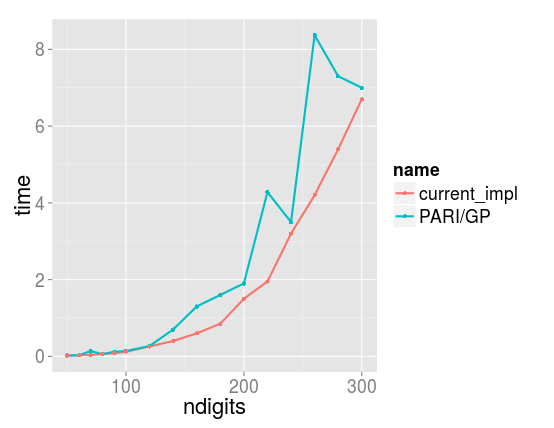
up to 300 digits
Next following article, I have implemented the better $s$ reduction function (_jacobi_config_reduce_s2()) which is the approximation of knapsack problem solution. We choose weight of each $q$ equal to $w(q) = \sum\limits_{p | q-1}{\phi^2(p^j)}$, where $\phi$ denotes Euler's function.  Then we find a prime power factor $q^k$ of $s$ with max $w(q)$ and set $s = s/q^k$. By doing this as long as possible, we will get a good $s$ value. It also gave a small speed boost. For better explanations and links you can look at chapter 4 of "Primality Testing and Jacobi Sums". As I see it is not implemented in PARI/GP aprcl.

Another thing which gave interesting results - I remove $t = 166320 = 2^4*3^3*5*7*11$ and always use $t = 720720 = 2^4*3^2*5*7*11*13$. If we use it together with $s$ reduction function we have ~0.5 second speed up for 300 digits prime (5.6 sec instead of 6.1). These is because we do not have a special sqr/mul functions for p = 13 or p = 27, but for p = 27 we have poly of length 17 and for p = 13 length = 12. After using $s$ reduction function in both cases we have $s$ of similar size, but use faster multiplication/squaring. It works for all numbers which are used t = 166320. Also in this place there is space for optimization, because now in final divison step we need to do 720720 multiplications and divisions, and it takes ~15% of all time.

The next thing to look at in the future is special functions sqr/mul for all $p$ values. I look at p = 13 and write result for squaring and I don't think that's a good idea to work with it manually. It look like some type of cse task and I think I can find some algorithm for this later...

I also add special multiplication functions for p = 3, 4, 5, 7, 8, 9, 11 and 16. It gave just a couple of percent increase, but almost for free :)

So, now test works 0.115 sec for 100 and 5.6 sec for 300 digits numbers (I think I have never posted my processor type - Core2Duo T6670 2.2GHz processor, so I do not have avx instructuions set, which may be can be used in gmp).

This week I want to fix all warnings I have, do some refactoring and add more documentation. I also want to add something similar to profile folder with primes of different sizes (from https://primes.utm.edu/lists/small/ , for example) and outputs. I have it for me, but it was written not very carefully and not committed.

Tuesday, 21 July 2015

GSoC week 8; More squaring functions

This week not much has changed, but I tried a couple of things that gave nothing.

After using Montgomery form for general multiplication and squaring I try to use it in special sqr functions (like unity_zp_sqr7). For this I add some modular functions for fmpz in Montgomery form (add, sub, mul: inlined in aprcl.h file) and add unity_zp_mont_sqr7() function. Using it instead of unity_zp_sqr7 and simple form works slower. Maybe, I implement something not very accurately.

I also add unity_zp_sqr11() function and it gave a good speed up (~10% for 300 digits number; we can test 300 digits $n$ for 7.3 sec). Functions like this give a better performance, but them require a lot time to code and debug. So far I have used the Supplement to Implementation of a New Primality Test, but the better way is to think about generalization.
from 50 to 100 digits

from 50 to 300 digits


On the other hand if I add similar functions for $p^k = 13, 27, 32$ this will be enough for the numbers up to ~1000 of digits. I also need to have a better look at $R$ and $s$ selection.

I think that I need to rewrite unity_zp_sqr and unity_zp_mul functions to reduce modulo $n$ after cyclotomic poly reduction, so we have less number of fmpz_mod function calls. 
Only 4 weeks left until soft GSoC deadline, so I have to start thinking about future code integration (as first step I want to create new branch and remove files related with Gauss sum test).

Valgrind callgrind call graphs for 100 and 300 digits numbers.

Tuesday, 14 July 2015

GSoC week 7; Montgomery modular stuff

This week I add squaring for p = 16 and it give good speed up for 100 digit prime (actually, for ~100 digit number used my implementations of squaring). After this we can prove 100 digit number primality for 0.13 sec and 300 digit number for 8.3 sec.

The next thing I was working on is Montgomery modular multiplication and reduction.
Firstly, we need to convert our unity_zp structure (recall that it is just a fmpz_mod_poly, mod = n) into Montgomery. For this we need to select $r > n$ such that $r = 2^k$ and compute $f * r$ there $f$ - unity_zp; so, element $x$ in Montgomery form can be represented as $x = a * r$, there $a$ from simple form. Because we do not want to use fmpz_mod or division functions we can store our unity_zp_mont data into fmpz_poly.  It was implemented in unity_zp_mont_to() and init functions.

Secondly, we need to implement basic operations. Addition and subtraction are the same as ordinary modular addition and subtraction: $x + y = a*r + b*r = (a + b)r = z$ there $x$, $y$ and $z$ in Montgomery form. Multiplications works a little harder: $x * y = (a*r) * (b*r) = (a*b)*r^2$, so we need to divide by $r$. To do it fast exists special REDC function, which uses the fact that $r = 2^k$ and we can use binary shift operations instead of division.

Using this form in exponentiation function gives small speed up (8 sec instead of 8.3 for 300 digits number). I think, if I implement REDC function in lower level (GMP have some implementations, but them not have public interface) this will give even a small increase in speed. Moreover, I not use REDC for small p = 4, 5, 7, 9 and 16, so Montgomery stuff not used for small numbers.

Sunday, 5 July 2015

GSoC week 6; Midterm and more optimizations

This week I refactor powering algorithms and add sliding window exponentiation implementation. It gave speed boost in couple of percent.

The next thing I do is add special squaring functions for small p values: powers of 2 (for 4 and 8); 3; 5; 7 (for details see the "Implementation of a New Primality Test" supplement). Selection of function going on unity_zp_sqr_inplace() and we need to have allocated memory for fmpz_t array (t).

It gives good speed boost (~10-15%), and for "small" numbers (near 100 digits) we catch up the PARI/GP implementation and I'm confident that we will soon become faster. For bigger values PARI/GP is still faster. Below the graphs with timings up to 100 and 300 digits:
50-100 digits

50-300 digits


I also looked at $(n - 1)$ test to replace computation in $\mathbb{Z}[\zeta_r]/(n)$ by $\mathbb{Z}/n\mathbb{Z}$, but I don't see that it will give a good speed gain.
Now I want to try reduce s value for fixed R (as in (4.) of "Primality Testing and Jacobi Sums"). After we compute s we can try to remove some factors without which we still have $s^2 > n$.

In total, over the past six weeks has been implemented APR-CL algorithm with good performance. Almost all of code is tested and documented. So now I need to finish special cases of multiplication and squaring and then try to optimize in general. Also we need to look closely at different initial values of R because the values from PARI/GP impair the performance (look at 70 digit numbers in first plot, for example).

Sunday, 28 June 2015

GSoC week 5; Some optimizations


This week I was working on the Jacobi sum test optimizations described in the last post.
First I add some fixed optimal $R$ values for $n$ with different number of digits. I also rewrite $s$ computation. This functions can be find here. It gave a good gain in speed, but I can add more intermediate $R$ values. It must be done carefully, because with smaller $R$ we can have worse $s$. This is shown in the graph, the PARI/GP implementation has many peaks.
mean time in seconds
Next I add $2^k$-ary powering algorithm. It gave ~20% gain in speed.

Also I do a lot of profiling using valgrind callgrind tool. I find that the computation of Jacobi sums takes a little time, so I'm not going to tabulate them.

I implement the final step of algorithm on condition that $s^3 > n$ using divisors in residue classes algorithm. After that all becomes slower. The divisors in residue classes algorithm have a good complexity $O((\ln n)^3$, but we need to call it thousands of times ($R = 2520$ for 100 digits $n$).

The next graph show timings for $n$ from 50 to 100 digits:
mean time in seconds

To better understand how selection of $R$ affects at the time I look at most slow part of algorithm ($n$-th powering in $\mathbb{Z}[\zeta_r] / (n)$) and count the number of operations.
This can be seen in the following tables for 100 and 300 digits numbers: 
DESCRIPTION DESCRIPTION
  
Also attach link to valgrind outputs for 100 and 300 digits prime. 

Next I want try to use directly fmpz_vec operations, without fmpz_mod_poly abstraction. After this I want to implement some formulas described in "Implementation of a New Primality Test" for fixed $r = p^k$.

Saturday, 20 June 2015

GSoC week 4; Jacobi sum test implementation and further optimizations

This week I implemented the basic version of Jacobi sum primality test. It is much faster then the test using Gauss sums. For example, primality proving of 50 digits prime using Gauss sum test takes ~200 seconds, and Jacobi sum test takes less then a second. The figure shows the number of up to 200 digits.
Implementation details are well described in "A Course in Computational Algebraic Number Theory" by H. Cohen and "Implementation of a New Primality Test" by H. Cohen and A. K. Lenstra. I also describe all the steps in code comments.

The image shows call graph output of valgrind --callgrind tool for 100 digits prime:
So, we can see that to improve the speed of algorithm we must reduce the number of multiplications (which are well optimized in flint).


Currently I have a very naive implementation of selecting $s$ and $R$ values (just trying increase $R = 2, 4, 6...$ until the proper $s$ is found). It can takes a lot of time and choose non-optimal parameters. For example, if we set $R = 98280$ it proves 200 digits number primality for ~8 seconds instead of 30. By $R = 166320$ we can prove 300 digits number in ~30 seconds. So I need to rewrite aprcl_config_init() function.

The next thing to do is replace the condition $s^2 > n$ to $s^3 > n$. Using "Divisors in Residue Classes" we can determine n divisors. It was implemented in flint before, so I need only add this step in Final division step.

Also I want to replace my basic powering algorithm in $\mathbb{Z}[\zeta] / (n)$ by $2^k$-ary method.

And finally we can precompute and store Jacobi sum in configuration structure (for 300 digits number computation of Jacobi sums takes ~40% of time) for testing numbers with a similar length.

This week I want to add this modifications and look in more detail the other opensource implementations.

Saturday, 13 June 2015

GSoC week 3; Road to Jacobi sum test

This week there are two important results:
  • Gauss sum test implemented and works;
  • Written operations in $\mathbb{Z}[\zeta_{p^k}]$.
The Gauss sum implementation was tested and, as expected, it works slowly. Proof of primality of 50 digits number: $29927402397991286489627837734179186385188296382227$ takes near 200 seconds.

To speed up the algorithm can be used Jacobi sums instead of Gauss sums. The Jacobi sum $J(\chi_1, \chi_2)$ defined by: $$J(\chi_1, \chi_2) = \sum\limits_{x \in \mathbb{Z}/q\mathbb{Z}}{\chi_1(x)\chi_2(1-x)}$$ $J(\chi_1, \chi_2) \in \mathbb{Z}[\zeta_p]$, much smaller finite ring, so the computation is much faster. As before we represent elements of $\mathbb{Z}[\zeta_p]$ as $\mathbb{Z}[X]/(X^p-1)$. It was implemented multiplication, addition, memory management, powering and reduction modulo cyclotomic polynomial $\Phi_{p^k}(x) = \sum\limits_{i = 0}^{p - 1}{x^{ip^{m-1}}}$. All these operations are documented and tested.

I also implement computation of Jacobi sum as described in "Implementation of a New Primality Test" by H. Cohen and A.K. Lenstra.

This week I am going to finish simple version of Jacobi sum test. Then we can implement some optimizations described in "Implementation of a New Primality Test" and, maybe, think about the new.